***Welcome to ashrafedu.blogspot.com * * * This website is maintained by ASHRAF***
Showing posts with label Synchronization. Show all posts

Monday, January 27, 2020

Monitors


Semaphores can be very useful for solving concurrency problems, but only if programmers use them properly. If even one process fails to abide by the proper use of semaphores, either accidentally or deliberately, then the whole system breaks down. For this reason a higher-level language construct has been developed, called monitors.

Monitor Usage

  • A monitor is essentially a class, in which all data is private, and with the special restriction that only one method within any given monitor object may be active at the same time. An additional restriction is that monitor methods may only access the shared data within the monitor and any data passed to them as parameters. i.e. they cannot access any data external to the monitor.

In order to fully realize the potential of monitors, one additional new data type, known as a condition can be defined.

  • A variable of type condition has only two legal operations, wait and signal. i.e. if X was defined as type condition, then legal operations would be X.wait( ) and X.signal( )
  • The wait operation blocks a process until some other process calls signal, and adds the blocked process onto a list associated with that condition.
  • The signal process does nothing if there are no processes waiting on that condition. Otherwise it wakes up exactly one process from the condition's list of waiting processes.

·           But now there is a potential problem - If process P within the monitor issues a signal that would wake up process Q also within the monitor, then there would be two processes running simultaneously within the monitor, violating the exclusion requirement.

·           Accordingly there are two possible solutions to this dilemma:
Signal and wait - When process P issues the signal to wake up process Q, P then waits, either for Q to leave the monitor or on some other condition.
Signal and continue - When P issues the signal, Q waits, either for P to exit the monitor or for some other condition.


Classic Problems of Synchronization


1. The Bounded-Buffer Problem

  • This is a generalization of the producer-consumer problem wherein access is controlled to a shared group of buffers of a limited size.
  • In this solution, the two counting semaphores "full" and "empty" keep track of the current number of full and empty buffers respectively ( and initialized to 0 and N respectively. ) The binary semaphore mutex controls access to the critical section. The producer and consumer processes are nearly identical - One can think of the producer as producing full buffers, and the consumer producing empty buffers.

2. The Readers-Writers Problem

  • In the readers-writers problem there are some processes ( termed readers ) who only read the shared data, and never change it, and there are other processes ( termed writers ) who may change the data in addition to or instead of reading it. There is no limit to how many readers can access the data simultaneously, but when a writer accesses the data, it needs exclusive access.
  • There are several variations to the readers-writers problem, most centered around relative priorities of readers versus writers.
    • The first readers-writers problem gives priority to readers. In this problem, if a reader wants access to the data, and there is not already a writer accessing it, then access is granted to the reader. A solution to this problem can lead to starvation of the writers, as there could always be more readers coming along to access the data. ( A steady stream of readers will jump ahead of waiting writers as long as there is currently already another reader accessing the data, because the writer is forced to wait until the data is idle, which may never happen if there are enough readers. )
    • The second readers-writers problem gives priority to the writers. In this problem, when a writer wants access to the data it jumps to the head of the queue - All waiting readers are blocked, and the writer gets access to the data as soon as it becomes available. In this solution the readers may be starved by a steady stream of writers.
  • The following code is an example of the first readers-writers problem, and involves an important counter and two binary semaphores:
    • readcount is used by the reader processes, to count the number of readers currently accessing the data.
    • mutex is a semaphore used only by the readers for controlled access to readcount.
    • rw_mutex is a semaphore used to block and release the writers. The first reader to access the data will set this lock and the last reader to exit will release it; The remaining readers do not touch rw_mutex. ( Eighth edition called this variable wrt. )
Note that the first reader to come along will block on rw_mutex if there is currently a writer accessing the data, and that all following readers will only block on mutex for their turn to increment readcount.

3. The Dining-Philosophers Problem

  • The dining philosophers problem is a classic synchronization problem involving the allocation of limited resources amongst a group of processes in a deadlock-free and starvation-free manner:
    • Consider five philosophers sitting around a table, in which there are five chopsticks evenly distributed and an endless bowl of rice in the center, as shown in the diagram below. ( There is exactly one chopstick between each pair of dining philosophers. )
    • These philosophers spend their lives alternating between two activities: eating and thinking.
    • When it is time for a philosopher to eat, it must first acquire two chopsticks - one from their left and one from their right.
    • When a philosopher thinks, it puts down both chopsticks in their original locations.

  • One possible solution, as shown in the following code section, is to use a set of five semaphores ( chopsticks[ 5 ] ), and to have each hungry philosopher first wait on their left chopstick ( chopsticks[ i ] ), and then wait on their right chopstick ( chopsticks[ ( i + 1 ) % 5 ] )
  • But suppose that all five philosophers get hungry at the same time, and each starts by picking up their left chopstick. They then look for their right chopstick, but because it is unavailable, they wait for it, forever, and eventually all the philosophers starve due to the resulting deadlock.

Some potential solutions to the problem include:
  • Only allow four philosophers to dine at the same time. ( Limited simultaneous processes. )
  • Allow philosophers to pick up chopsticks only when both are available, in a critical section. ( All or nothing allocation of critical resources. )
  • Use an asymmetric solution, in which odd philosophers pick up their left chopstick first and even philosophers pick up their right chopstick first. ( Will this solution always work? What if there are an even number of philosophers? )


Wednesday, January 22, 2020

Semaphores


Semaphores are integer variables that are used to solve the critical section problem by using two atomic operations, wait and signal that are used for process synchronization.

The definitions of wait and signal are as follows:

1.    Wait

The wait operation decrements the value of its argument S, if it is positive. If S is negative or zero, then no operation is performed.
wait(S)
{  
    while (S<=0);
  
     S--;
}

2.    Signal

The signal operation increments the value of its argument S.
signal(S)
{
    S++;
}

All modifications to the integer value of the semaphore in the wait() and signal() operations must be executed indivisibly. That is, when one process modifies the semaphore value, no other process can simultaneously modify that same semaphore value. In addition, in wait(S), the testing of the integer value of S (S ≤ 0), as well as its possible modification (S--), must be executed without interruption.

1. Semaphore Usage

Semaphores can take on one of two forms:

  • Binary semaphores can take on one of two values, 0 or 1. They can be used to solve the critical section problem and can be used as mutexes on systems that do not provide a separate mutex mechanism.

  • Counting semaphores can take on any integer value, which is equal to available resources. The counter is initialized to the number of such resources available in the system, and whenever the counting semaphore is greater than zero, and then a process can enter a critical section and use one of the resources. When the counter gets to zero ( or negative in some implementations ), then the process blocks until another process frees up a resource and increments the counting semaphore with a signal call.

Semaphores can also be used to synchronize certain operations between processes.
For example, suppose it is important that process P1 execute statement S1 before process P2 executes statement S2.

  • First create a semaphore named sync that is shared by the two processes, and initialize it to zero.
  • Then in process P1 we insert the code:
                        S1;
                        signal( sync);
  • and in process P2 we insert the code:
                        wait( sync );
                        S2;
  • Because sync was initialized to 0, process P2 will block on the wait until after P1 executes the call to signal.

2. Semaphore Implementation

The big problem with semaphores is the busy loop in the wait call, which consumes CPU cycles without doing any useful work. This type of lock is known as a spinlock, because the lock just sits there and spins while it waits. While this is generally a bad thing, it does have the advantage of not invoking context switches, and so it is sometimes used in multi-processing systems when the wait time is expected to be short - One thread spins on one processor while another completes their critical section on another processor.

An alternative approach is to block a process when it is forced to wait for an available semaphore, and swap it out of the CPU. In this implementation each semaphore needs to maintain a list of processes that are blocked waiting for it, so that one of the processes can be woken up and swapped back in when the semaphore becomes available. The new definition of a semaphore and the corresponding wait and signal operations are follows:


Each semaphore has an integer value and a list of processes list. When a process must wait on a semaphore, it is added to the list of processes. A signal() operation removes one process from the list of waiting processes and awakens that process.

The wait() and signal() semaphore operation can be defined as:


In this implementation the value of the semaphore can actually become negative, in which case its magnitude is the number of processes waiting for that semaphore. This is a result of decrementing the counter before checking its value.

Key to the success of semaphores is that the wait and signal operations be atomic, that is no other process can execute a wait or signal on the same semaphore at the same time. ( Other processes could be allowed to do other things, including working with other semaphores, they just can't have access to this semaphore. )

On single processors this can be implemented by disabling interrupts during the execution of wait and signal; Multiprocessor systems have to use more complex methods, including the use of spinlocking.

3. Deadlocks and Starvation

One important problem that can arise when using semaphores to block processes waiting for a limited resource is the problem of deadlocks, which occur when multiple processes are blocked, each waiting for a resource that can only be freed by one of the other ( blocked ) processes.

Suppose that P0 executes wait(S) and then P1 executes wait(Q).When P0 executes wait(Q), it must wait until P1 executes signal(Q). Similarly, when P1 executes wait(S), it must wait until P0 executes signal(S). Since these signal() operations cannot be executed, P0 and P1 are deadlocked.

Another problem to consider is that of starvation, in which one or more processes gets blocked forever, and never get a chance to take their turn in the critical section. Indefinite blocking may occur if processes are removed from the list associated with a semaphore in LIFO (last-in, first-out) order.

4. Priority Inversion

A scheduling challenge arises when a high-priority process gets blocked waiting for a resource that is currently held by a low-priority process.

If the low-priority process gets pre-empted by one or more medium-priority processes, then the high-priority process is essentially made to wait for the medium priority processes to finish before the low-priority process can release the needed resource, causing a priority inversion. If there are enough medium-priority processes, then the high-priority process may be forced to wait for a very long time.

One solution is a priority-inheritance protocol, in which a low-priority process holding a resource for which a high-priority process is waiting will temporarily inherit the high priority from the waiting process. This prevents the medium-priority processes from preempting the low-priority process until it releases the resource, blocking the priority inversion problem.


Peterson’s Solution


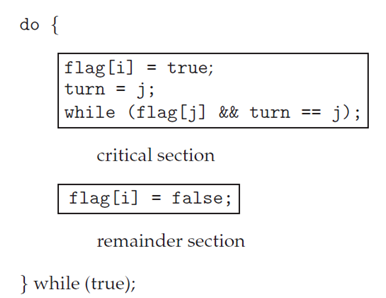
A classic software based solution to the critical section problem is Peterson’s solution. It is not guaranteed that Peterson’s solution will work correctly on modern architectures.

Peterson’s solution is restricted to two processes that alternate execution between their critical sections and remainder sections.

Peterson’s solution requires the two processes to share two data items:

int turn; - Indicates whose turn it is to enter into the critical section. If turn = = i, then process i is allowed into their critical section.

boolean flag[2]; - Indicates when a process wants to enter into their critical section. When process i wants to enter their critical section, it sets flag[ i ] to true.


In the above diagram, the entry and exit sections are enclosed in boxes.

  • In the entry section, process i first raises a flag indicating a desire to enter the critical section.
  • Then turn is set to j to allow the other process to enter their critical section if process j desires.
  • The while loop is a busy loop ( notice the semicolon at the end ), which makes process i wait as long as process j has the turn and wants to enter the critical section.
  • Process i lowers the flag[ i ] in the exit section, allowing process j to continue if it has been waiting.
To prove that the solution is correct, examine the three conditions listed:

  1. Mutual exclusion - If one process is executing their critical section when the other wishes to do so, the second process will become blocked by the flag of the first process. If both processes attempt to enter at the same time, the last process to execute "turn = j" will be blocked.
  2. Progress - Each process can only be blocked at the while if the other process wants to use the critical section (flag[j] = = true), AND it is the other process's turn to use the critical section (turn = = j). If both of those conditions are true, then the other process ( j ) will be allowed to enter the critical section, and upon exiting the critical section, will set flag[ j ] to false, releasing process i. The shared variable turn assures that only one process at a time can be blocked, and the flag variable allows one process to release the other when exiting their critical section.
  3. Bounded Waiting - As each process enters their entry section, they set the turn variable to be the other processes turn. Since no process ever sets it back to their own turn, this ensures that each process will have to let the other process go first at most one time before it becomes their turn again.

Process Synchronization - Critical Section Problem


Process Synchronization

Process Synchronization means sharing system resources by processes in a such a way that, Concurrent access to shared data is handled thereby minimizing the chance of inconsistent data. Maintaining data consistency demands mechanisms to ensure synchronized execution of cooperating processes. Process Synchronization was introduced to handle problems that arise while multiple process executions.

Critical Section Problem

A Critical Section is a code segment that accesses shared variables and has to be executed as an atomic action. It means that in a group of cooperating processes, at a given point of time, only one process must be executing its critical section. If any other process also wants to execute its critical section, it must wait until the first one finishes.


The critical-section problem is to design a protocol that the processes can use to cooperate. Each process must request permission to enter its critical section. The section of code implementing this request is the entry section. The critical section may be followed by an exit section. The remaining code is the remainder section.
A solution to the critical section problem must satisfy the following three conditions:

1. Mutual Exclusion
Out of a group of cooperating processes, only one process can be in its critical section at a given point of time.

2. Progress
If no process is in its critical section, and if one or more threads want to execute their critical section then any one of these threads must be allowed to get into its critical section.

3. Bounded waiting.
There exists a bound, or limit, on the number of times that other processes are allowed to enter their critical sections after a process has made a request to enter its critical section and before that request is granted.